Ceasefires
Key findings from PeaceRep research on ceasefires (2021 – 2026)
PeaceRep research on ceasefires was led by the University of Edinburgh.
PeaceRep research on ceasefires primarily derives from the PA-X Peace Agreement Database and Dataset (Bell et al. 2024; Bell and Badanjak 2019), a core resource for understanding the current practice and historical development of formal peace processes. PA-X has provided the comparative, large-scale insight into the contemporary practice of brokering ceasefires. In addition to PA-X, two more bodies of PeaceRep research contributed to our understanding of ceasefires: first, the work on the Mediation Event and Negotiator Database (MEND) (Peter et al. 2025), and the work related to specific case studies and contexts, such as Sudan, Ukraine, and Myanmar.
PeaceRep research into features and trends of contemporary ceasefires has shown:
- In the past 20 years, ceasefires have become the main outcome of formal negotiations, whereas they formed part of more comprehensive attempts at conflict resolution in the more immediate post-Cold-War period. This is related to two dynamics. First, there is a focus on ceasefires as core security arrangements in internal conflicts, with few attempts to negotiate for comprehensive political and social change. Second, we are also witnessing a resurgence of interstate conflicts and internationalised internal conflicts, which further accentuates this separation of ceasefires as security arrangements from political settlements as a form of conflict resolution.
- Ceasefires are often negotiated to support a particular social or humanitarian aim – such as public health intervention, exchange of prisoners, or evacuation of civilians – but these ceasefires typically do not act as first steps in forming a peace process. Instead, these arrangements are limited in aims and ambition and should be evaluated as such.
- In terms of the content of agreements, provision for ceasefire is most often occurring in conjunction with topics related to security and humanitarian issues, as opposed to being embedded in documents that attempt to outline the terms of wider political and social settlement.
- Ceasefire agreements are often supported by third parties – though there have been significant changes in the composition of external support for ceasefires over the past decade, with UN no longer the most frequent third-party signatory to ceasefire agreements.
Browse key findings in the tabs below.
Definitions
There is no commonly agreed on or legal definition of the term ceasefire. In PeaceRep research, a ceasefire is defined as a call to permanently or temporarily terminate hostilities between conflict parties and can take the form of a unilateral announcement, bilateral or multilateral agreement (Forster 2019b; Forster and Bell 2019).
The terms armistice, ceasefire, truce and cessation of hostilities are used interchangeably in practice, despite having differing meanings under international law. Parties may also avoid referring to an arrangement as a ceasefire due to the political repercussions associated with ceasefires. Instead, terms such as joint statement, memorandum, declaration, or peace accord may be used (Forster 2019a; Forster 2019b).
Ceasefires are often seen as a first step for belligerents to enter into negotiations and find opportunities for more sustainable peace. However, the non-linear nature of peace processes means that ceasefires are not always necessary for parties to enter into comprehensive peace negotiations, and ceasefires do not always lead to more comprehensive peace negotiations (Forster 2019a; Forster 2019b).
The PA-X Database differentiates between ceasefire provisions contained within peace agreements (which can occur at any time) and ceasefire agreements that have the primary purpose of limiting violence and often feature at the early stages of peace talks (Forster 2019a; PA-X Database). The Mediation Event and Negotiator Database (MEND) also records ceasefires reached informally, without a released text (Peter et al. 2025).
In addition to the aim of suspending hostilities, the purpose of a ceasefire is defined by its scope, degree of inclusion and implementing actors (Forster 2019b).
Features of contemporary ceasefires
Ceasefire agreements and ceasefire arrangements have become more prominent features of attempts to broker peace. There has been a shift in both the frequency and placement of ceasefire arrangements within formal talks: from around 2008, ceasefire arrangements are more often found in standalone agreements rather than as components within agreements that also attempt to regulate more substantive issues and provide a broader settlement (Figure 1; Bell and Badanjak 2019). The numerous agreements signed in Colombia during the Total Peace initiative have been an exception to this – when these are excluded from analysis, the trend for the rest of the world becomes even more stark.
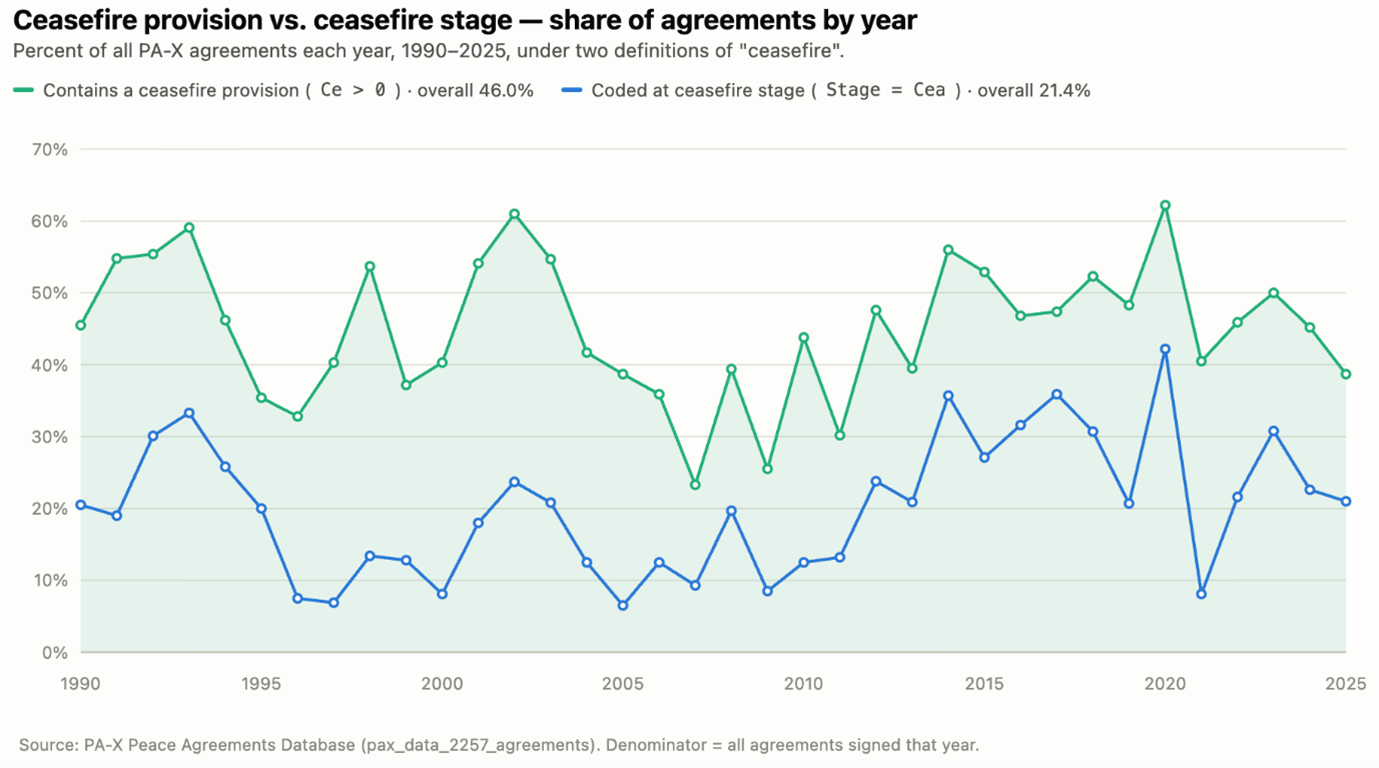
Ceasefire is always a central component of peace talks, however, a ceasefire on its own is not sufficient for conflict resolution in the long term. PeaceRep research, drawing across peace agreements, mediation events, and case studies, suggests that the contemporary ceasefires are lacking the bigger package of agreed measures to support political transformation and long-term conflict resolution, and instead embody more pragmatic, minimalist modes of peacemaking (Badanjak et al. 2026; Adhikari et al. 2026).
In 2025 and 2026, informal, non-written ceasefires were reached more frequently than written, formal ceasefires, or in fact, any kind of formal written agreement, emerging from ad hoc negotiations, back-channel diplomacy, or humanitarian necessity. These ceasefires were often put into place to achieve limited humanitarian goals, such as prisoner exchanges or humanitarian access, and have featured support from a variety of external actors (Peter et. al. 2025; Peter et. al. 2026). Alongside this general trend, we may be witnessing a resurgence of ceasefires signed in interstate conflicts and in internationalised internal conflicts: in 2023, ceasefire agreements were being signed primarily in internal conflict but in 2025, ceasefire agreements have been signed mostly by states engaged in interstate conflict (Badanjak et al. 2026).
Ceasefire arrangements and ceasefire agreements: trends and drivers
The trends in frequency of ceasefires are likely driven by a complex set of causes, and PeaceRep research has identified one strand that points to the importance of political economy of the peace dividend. In contexts rich in oil, there has been a correlation between trends in oil prices and types of agreements being signed: when prices are high, the flow of funds from oil exports creates an incentive for elites to come to agreements about governance (Pospisil 2024). Global powers’ energy needs and considerations of de-carbonization may also drive their interest and decision-making in engaging in or withdrawing from peaceful conflict resolution initiatives (Pospisil 2024; Spatz, Sarkar, and de Waal 2023; Cooper 2025). The political economy of ceasefires goes beyond natural resource extraction and economic transitions to other capital projects: for example, the explicit linking of ceasefire negotiations and the participation of third-parties to the commercial potential for external actors in conflict-affected areas (Badanjak et. al. 2026; Wise and Farquhar 2026).
While commercial aims of peacemaking have dominated the discussions of peace processes in 2026, long term trends in ceasefires show the potential for limited but nevertheless successful ceasefires in support of humanitarian law, public health, and protection of civilians. Building on our earlier ceasefires research in relation to the Covid-19 pandemic (Allison et al. 2021; Wise et al. 2021), there is a tradition of ceasefires aimed at providing access to medical professionals for public health interventions since the 1980s (Russell, Wise, and Badanjak 2021). Historically, these ceasefires have tended to be successful in attaining their immediate aim but cannot be understood as steps towards a more comprehensive agreement between the warring sides However, even this potential for limited success may be harder to reach within contemporary fragmented conflicts with low levels of trust in medical professionals, and as norms around humanitarian and public health access have been eroded (Wise et al. forthcoming).
Content of ceasefire agreements and ceasefire arrangements
In terms of how they provide for ceasefire, contemporary ceasefire agreements do not differ from earlier ceasefires, as they aim to resolve the same security and informational dilemmas as any earlier document. These provisions tend to address issues such as a clear statement of the time at which a ceasefire is to start, some arrangement for ceasefire monitoring and verification, and they often outline the requirement to ensure humanitarian access and intervention for civilians and combatants alike (Forster 2019a; Badanjak forthcoming).
These characteristics, particularly those regarding humanitarian access and monitoring, often match the on-the-ground expectations regarding ceasefires. In Ukraine, civic activists conducting evacuations from Russian-occupied territories made three key recommendations for issues to be included within a ceasefire during (failed) talks in Saudi Arabia: to ensure access and guaranteed safety of human rights monitors in the area, to ensure free movement across lines of control, and to ensure release of arbitrarily detained captives of the Russian regime in occupied areas (Cooper et al. 2025).
Considering all agreements that in some way include ceasefire arrangements (rather than looking at agreements that primarily outline a ceasefire), provision for ceasefire is most often occurring in conjunction with topics related to security and humanitarian issues, instead of topics that govern or establish a wider political and social settlement. A comparison of topics in agreements from the 2020 to 2025 period with those signed in the preceding 20 years shows that the latter topics have become less likely to co-occur with provision for ceasefire. If an agreement contains a ceasefire provision in 2020-2025, it is less likely to also address topics such as reconciliation, democracy, or development than a similar agreement from 1999-2019 (Badanjak forthcoming). This is line with our broader finding of reduced number of substantive, and particularly comprehensive agreements, that aim to provide a wide-ranging political and social transformation for transition out of armed conflict.
We have also identified a marked change in the third parties that support agreements by acting as witnesses or guarantors (Badanjak and Henry). In the past five years, the UN has been overtaken as the most frequent third-party signatory of ceasefires by not just one but by twelve third-party actors. This does not mean that the UN and its missions, agencies, and envoys have disengaged from active participation in supporting ceasefires but their ability to play a decisive role and to be seen as crucial guarantors and witnesses has been eroded (Badanjak forthcoming).
Ceasefire agreements consistently ignore or neglect gender. Our research finds that only 15% of ceasefire agreements signed between 2000 and 2015 contain provisions relating to women, girls, and gender, and this drops slightly to 12% between 2016 and 2025 (PA-X Peace Agreement Database, Version 10, 2026). The increasing use of ceasefires within contemporary mediation therefore has implications for the prevalence and substantiveness of gender references (Wise 2026).
Regarding monitoring, ceasefires should clearly set out key technical details to minimize the space for signatories to contest it. This includes key questions such as the composition of the monitoring body, where monitoring will be employed and the tasks the monitoring bodies will undertake, and will depend upon a range of contextual factors (Buchanan, Clayton and Ramsbotham 2021).
Background and past research
PeaceRep research on ceasefires builds on research from our predecessor programme, the Political Settlements Research Programme (2015 – 2021).
Scope and modalities
Our research finds that the scope of ceasefires varies depending on a range of technical decisions:
- geographical scope – it can be limited to one neighbourhood or check point, or cover whole countries, or apply in-between states;
- which parties are involved – both in terms of who should comply with the ceasefire, but also in terms of who is implementing it and who is monitoring it (for implementation and monitoring see below);
- date and time when arrangements come into force;
- duration of a ceasefire – this can be, but is not always, formally agreed in the ceasefire agreement;
- whether modalities are sequenced, timetabled or phased – key modalities often include withdrawal of troops, release of prisoners and handover of armaments (Forster 2019b).
These technical decisions are in turn determined by what the immediate needs of the actors involved are, the general context of the conflict, whether the ceasefire is agreed at a local, national or international level, and the stage of the process in which it is agreed (Forster 2019a; Forster and Bell 2019).
Our research finds that in addition to provisions aimed at ending forms of violence, ceasefire provisions generally fall into three main areas:
- humanitarian provisions;
- security provisions;
- provisions to mitigate conflict escalation (Forster 2019a).
Ceasefire agreement agreed at a later stage of a conflict will have provisions shaped by the possibility of a more durable peace, as opposed to a more immediate cessation of hostilities (Forster and Bell 2019). Conversely, ceasefires which are intended to create ‘humanitarian corridors’ and provide situations of momentary reprieve for humanitarian purposes are often intentionally decoupled from the wider political context by practitioners (Wise, Badanjak, Bell and Knaussel 2021).
A key aspect of a ceasefires’ security provisions are provisions on ceasefire violations and potential exceptions to ceasefire violations. Forster (2019a, 2019b) finds that ceasefire violations usually fall into two overlapping categories:
- human rights violations – most commonly related to the protection of non-combatants;
- prohibition of military activities.
Exceptions can include activities such as peace-keeping and policing and the right to self-defence.
Humanitarian ceasefires
In addition to potentially forming a stepping-stone to comprehensive peace negotiations, our research finds that ceasefires can be used to allow for ‘humanitarian corridors’, to mark festivals and religious occasion, to build confidence between conflicting parties, or as a cover to allow warring parties to remobilize, rearm and manoeuvre (Forster 2019a; Badanjak and Wise 2020).
We have found little historical evidence for vaccination ceasefires, or the related ceasefires that were agreed or announced to combat the Covid-19 pandemic, translating into progress in wider peace processes. It appears unlikely that vaccination ceasefires can directly jumpstart broader negotiations. At best, such arrangements may contribute to the temporary building of trust among warring parties and between armed groups and humanitarian actors (Russell, Wise and Badanjak 2021). However, the more likely outcome is that any transient event or external shock soon becomes yet another part of the conflict situation, rather than a factor that can significantly alter conflict dynamics.
Our research also shows that past vaccination ceasefires were primarily aimed at immunising children. For infectious diseases that also affect adults off all ages, however, their health may have more direct and immediate consequences for conflict dynamics. This may lead armed groups to consider pandemics and vaccination as immediate tactical issues which can affect their standing more than a campaign aimed at children would, making it less probable that vaccination ceasefires can be used to build trust between warring parties (Russell, Wise and Badanjak 2021).
Our research also suggests that instead of focussing on the use of vaccination ceasefires as peacebuilding activities, such interventions should be viewed as one of a range of actions that can help to address public health needs and outcomes in areas affected by conflict. Vaccination ceasefires should not be treated as a mechanism for revitalising stalled peace processes or for initiating new ones (Russell, Wise and Badanjak, 2021).
Monitoring
Monitoring of ceasefires significantly adds to their durability as it increases accountability, adherence and confidence in the process, can help build trust between the parties, and creates structures to manage incidents that arise (Buchanan, Clayton and Ramsbotham 2021; Forster 2019b).
For monitoring to be successful, ceasefires should clearly set out key technical details to minimize the space for signatories to contest it. This includes key questions such as the composition of the monitoring body, where monitoring will be employed and the tasks the monitoring bodies will undertake, and will depend upon a range of contextual factors (Buchanan, Clayton and Ramsbotham 2021).
Our research finds that ceasefire monitoring has seen three key developments in recent years (Buchanan, Clayton and Ramsbotham 2021):
- International actors have traditionally played a key part in monitoring ceasefires (alone or together with the conflicting parties). However, there is a growing reluctance from global-north actors to engage in ceasefire monitoring due to increasingly challenging and complex environments for peace keeping missions;
- The inclusivity of orthodox monitoring models have been questioned;
- The need for conflicting parties to have a sense of ownership to the monitoring mechanism has been highlighted.
As result of these trends, there is increasing contribution from civilians and civilian society in ceasefire monitoring as well as an increased use of technologies such as cameras, smartphones and drones (Buchanan, Clayton and Ramsbotham 2021).
International actors still play a crucial role in monitoring arrangements through supporting monitoring tools such as facilities and meditation support (Buchanan, Clayton and Ramsbotham 2021; Forster 2019b).
Inclusion
Whilst ceasefires predominantly tend to focus on armed actors and halting fighting, they have sustained impact on pathways to peace and the wider security concerns of civilians (Bell and Forster 2019).
Ceasefire agreements consistently ignore or neglect gender. Our research finds that only 38 out of 411 ceasefire agreements (9%) signed between 1990 and 2021 contain provisions relating to gender and ceasefires (PA-X Peace Agreement Database, Version 6, 2022; Wise and Asproni 2022).
Where provisions relating to women and gender are included in ceasefires, these provisions commonly relate to the prohibition of sexual and gender-based violence, the prioritization of women and children during prison release exchange and women’s interest and needs in demobilization efforts (Bell and Forster 2019).
Including gender provisions in ceasefires is important as it has the potential to establish the logic of inclusion for any superseding peace talks and can emphasise the need for and relevance of women’s expertise (Bell and Forster 2019).
Provisions relating to women and gender can be included as a part of human rights clauses, or by including non-discrimination clauses in ceasefires as a type of ‘hook’ for other general and gender-specific rights (Bell and Forster 2019).
Our research finds that strategies for increasing the inclusion of provision relating to women and gender in ceasefires have ranged from women in civil society ‘gender editing’ ceasefires (as done with the Nationwide Ceasefire Agreement in Myanmar), to bolstering grassroot conciliation mechanisms (Libya), and establishing gender panels to help to develop inputs into the mediation process and highlight gender components (Colombia) (Bell and Forster 2019).
Our research also finds that the increasing civilian and civil society movement involvement in ceasefire monitoring provides the opportunity for inclusion of often overlooked groups such as women (Buchanan, Clayton and Ramsbotham 2021).
References
PeaceRep’s key findings series presents a top-line overview of findings from the breadth and depth of the consortium’s data-driven and in-country research between 2021 – 2027. The findings presented here represent our main contributions to the field, but are not necessarily exhaustive of all PeaceRep work on each thematic and geographic area. Read the individual works linked here for more detailed analysis.
Researchers and contributors
Monalisa Adhikari, Johanna Amaya-Panche, Amuda Baba, Benjamin Bach, Sanja Badanjak, Juline Beaujouan, Christine Bell, Devanjan Bhattacharya, Luke Cooper, Elisa D’Amico, Alex de Waal, Tim Epple, Jean-Benoit Falisse, Adam Farquhar, Sophie Gueudet, Héloïse Guichardaz, Niamh Henry, Jennifer Hodge, Kasia Houghton, Anna Kostenko, Mateja Peter, Jan Pospisil, Anna Prokhorova, Ian Russell, Aditya Sarkar, Benjamin Spatz, Robert Wilson, Laura Wise.
Suggested citation
Sanja Badanjak and Laura Wise (2026). PeaceRep Key Findings: Ceasefires (Updated from Ceasefires Key Findings, as compiled by the PeaceRep UoE team). PeaceRep: The Peace and Conflict Resolution Evidence Platform, University of Edinburgh.
References
PeaceRep work cited
Adhikari, M., Hodge, J., & Wise, L. (2026). Peace Process Lite: When Global Fragmentation Meets Conflict Fragmentation (British Academy Discussion Paper). London: British Academy and Carnegie Endowment for International Peace. https://doi.org/10.5871/globaldisorder/9780856727160
Badanjak, S., Amaya-Panche, J., Beaujouan, J., Epple, T., Farquhar, A., Henry, N., Wilson, R., and Wise, L. (2025). Peace Agreements in 2024: Insights from the PA-X Peace Agreements Database. PeaceRep: The Peace and Conflict Resolution Evidence Platform, University of Edinburgh
Badanjak, S. and Henry, N. (2025). Peace Agreement Actors Dataset (PAA-X), 1990-2023 [dataset]. University of Edinburgh. School of Law. https://doi.org/10.7488/ds/7932.
Badanjak, S., Wise, L., Farquhar, A., Guichardaz, H., Wilson, R. and Epple, T. (2026). Peace Agreements in 2025. PeaceRep: The Peace and Conflict Resolution Evidence Platform, University of Edinburgh.
Bell, C., Badanjak, S., Farquhar, A., Beaujouan, J., Epple, T., Forster, R., Jamar, A., et al. (2024). PA-X Peace Agreement Database and Dataset: Codebook, Version 8. PeaceRep: The Peace and Conflict Resolution Evidence Platform, University of Edinburgh
Cooper, L. (2025). Russo-Ukrainian War: The Political Economy of the Present Balance of Forces. PeaceRep: The Peace and Conflict Resolution Evidence Platform, University of Edinburgh.
Cooper, Luke, Kostenko, A., Prokhorova, A., and Gueudet, S. (2025). Life under Occupation in the Russo-UkrainianWar: Insights from Activist Networks. PeaceRep: The Peace and Conflict Resolution Evidence Platform, University of Edinburgh
Peter, M. (2025). Mediation in 2024: First Insights from the MEND Database. Edinburgh: PeaceRep, University of Edinburgh. PeaceRep: The Peace and Conflict Resolution Evidence Platform, University of Edinburgh
Peter, M., Badanjak, S., D’Amico, E., and Houghton, K. (2025). Mediation Event and Negotiators Database (MEND). doi:10.7910/dvn/pyrhs6.
Peter, M, D’Amico, E., Houghton, K., and Badanjak, S. (2026). Mediation in 2025: Navigating Overlapping Conflict Systems. PeaceRep: The Peace and Conflict Resolution Evidence Platform, University of Edinburgh. https://doi.org/10.7488/era/7185.
Pospisil, J. (2024). The New Era of Turbulence: Peacemaking Trends in Post-Carbon Times. Environment and Security 2(3): 375–91. doi:10.1177/27538796241272366.
Spatz, B., Sarkar, A., and de Waal, A. (2023). Decarbonization and Conflict Resolution: New Patterns of Peacemaking in Political Marketplace Systems and Its Implications for the Clean Energy Transition. PeaceRep: Peace and Conflict Resolution Evidence Platform, University of Edinburgh.
Wise, L. (2026). Gender References in Peace Agreements in 2025: Insights from the PA-X Database. [PA-X Data Series]. PeaceRep: The Peace and Conflict Resolution Evidence Platform, University of Edinburgh. https://doi.org/10.7488/era/7195
Wise, L., and Farquhar, A. (2026). “Ending Wars or Making Deals? What PA-X Data Say about American Mediation in 2025 – PeaceRep.” PeaceRep blog. https://peacerep.org/2026/05/22/ending-wars-or-making-deals/ (September 30, 2026).
Wise, L., Russell, I., Falisse, J., Baba, A., and Badanjak, S. (forthcoming). Considerations for negotiating an Ebola truce in DR Congo.
Other cited work
Allison, J., Badanjak, S., Bach, B., Bell, C., Bhattacharya, D., Knaussel, F., Wise, L. (2020). ‘An interactive tracker for ceasefires in the time of Covid-19.’ The Lancet Infectious Diseases, 14 December 2020. DOI: 10.1016/S1473-3099(20)30932-4
Badanjak, S. and Wise, L. (2020). Peace on Earth? The Tradition of Christmas Ceasefires Across the World [blog]. Covid Collective: University of Edinburgh. https://peacerep.org/2020/12/23/christmas-ceasefires/
Bell, C., and Badanjak, S. (2019). “Introducing PA-X: A New Peace Agreement Database and Dataset.” Journal of Peace Research 56(3): 452–66. doi:10.1177/0022343318819123.
Buchanan, C., Clayton, G. and Ramsbotham, A. (2021). Ceasefire monitoring: developments and complexities. Accord Spotlight. UK: Conciliation Resources and Political Settlements Research Programme.
Forster, R. (2019). ‘Ceasefires’. In Romaniuk, S., Thapa M., and P. Marton (eds.) The Palgrave Encyclopedia of Global Security Studies. Cham, Palgrave MacMillan https://doi.org/10.1007/978-3-319-74336-3_8-2
Forster, R. (2022). Ceasefire Arrangements: Ceasefires Quick Guide. PA-X Spotlight Series. University of Edinburgh: Political Settlements Research Programme. https://peacerep.org/publication/ceasefire-arrangements/
Forster, R. and Bell, C. (2019). Gender Mainstreaming in Ceasefires: Comparative Data and Examples (PA-X Report, Spotlight Series). Edinburgh: Global Justice Academy, University of Edinburgh. https://peacerep.org/publication/gender-mainstreaming-in-ceasefires-comparative-data-and-examples/
Russell, I., Wise, L. and Badanjak, S. (2021). “VaxxPax: A Dataset of Vaccination Ceasefires.” Edinburgh. https://doi.org/10.7488/ds/3131.
Wise, Laura, Sanja Badanjak, Christine Bell, and Fiona Knäussel. 2021. “Pandemic Pauses: Understanding Ceasefires in a Time of Covid-19.” Edinburgh: Global Justice Academy, University of Edinburgh.