In this final blogpost under the PeaceRep programme, Nisar Majid brings attention to the regional entanglements of political, security and financial interests in the Ethiopia, Kenya and Somalia borderlands, focusing on checkpoints – or chokepoints – in Jubbaland.
The blog explores how control over trade ‘chokepoints’ is central to political power in Somalia, shaping alliances between local elites and external actors like Ethiopia and Kenya.
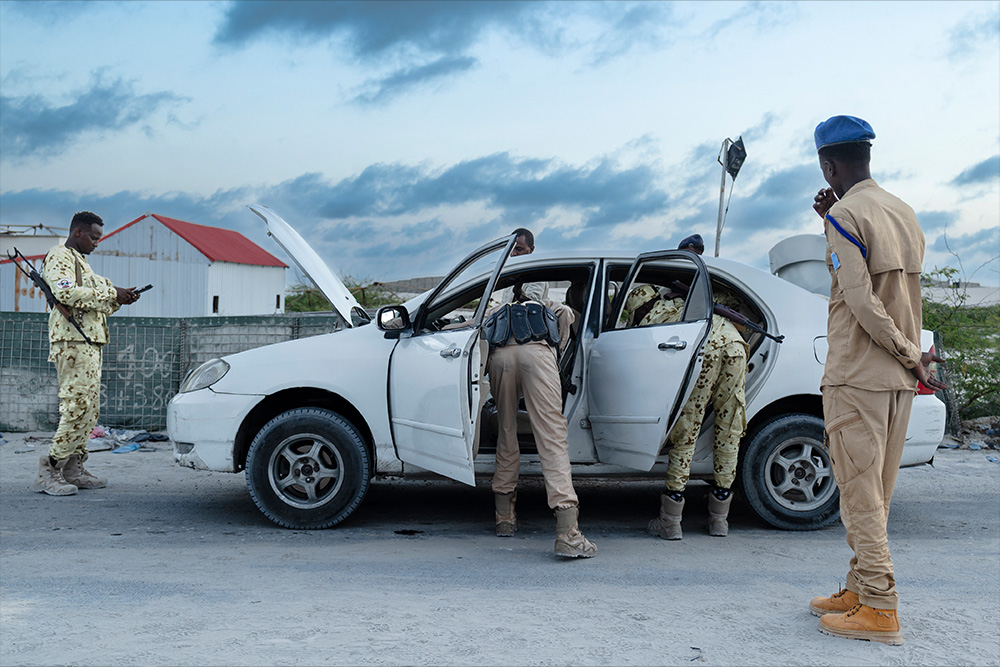
Checkpoints, Regional Entanglements and Political Entrepreneurs
Over the last 30 years, Ethiopia’s political and security influence and entanglement in Somalia have been profound. In the early 1990s, this was initially driven by the Tigrayan-led Ethiopian Peoples’ Revolutionary Democratic Front (EPRDF) as it asserted its dominance over Ethiopia’s federal government system. This took place while Somalia’s central state collapsed and its post-state political order evolved in a more fragmented manner. This entanglement is in part a function of the vast border that separates the two countries, which includes all of the sub-national polities of Somalia alongside Ethiopia’s Somali Regional State (SRS). Kenya’s entanglement with Somalia is more limited temporally and spatially than Ethiopia’s, given its later engagement (from 2010), following the rise of Al Shabaab, and its smaller border region with Somalia where the Federal Member State (FMS) of Jubbaland marks the boundary.
Somali East Africa is a deeply interconnected economic and trading area, with Somalia’s seaports connecting distant markets with the Somali populated hinterland and further into Ethiopia, Kenya and beyond. The ‘chokepoints’ associated with these trade corridors, whether at the seaports themselves or along the various interior trade routes – and associated checkpoints – are critical sites of power and resource accumulation. As such, they have attracted and empowered a range of political entrepreneurs.
Hagmann and Stepputat (2023, 7)[1] describe this political and economic space as a ‘complex patchwork of “trading states” … de facto states, de jure states, national – including Ethiopia, Kenya, and Djibouti – and sub-national state entities’, and as part of a ‘logistics frontier’ within global trading networks. A similar characterisation, though driven from a distinct but overlapping analytical perspective – the political marketplace – emanates from Alex de Waal (2020, 561), who describes Somalia as a ‘disassembled patchwork of public authorities and political entrepreneurs.’[2]
Checkpoints are key sites in the circulation of goods and people, sites that Peer Schouten associates with ‘roadblock politics’, where ‘politico-military actors of all stripes focus their efforts’ and ‘finance their exploits’ (2022, 4).[3] In a forthcoming article we highlight the evolution of two prominent political entrepreneurs in this space in Jubbaland, and the implications for the emergent federal system. Jubbaland provides an interesting case in the political function of checkpoints. Its two main trade corridors bisect this regional state, with the seaport of Kismayo the primary chokepoint in a short trade corridor to Kenya. Meanwhile, Mogadishu is the major hub for trade that passes through Baidoa and on to Dolo in northern Gedo, before splitting into onward legs to Kenya and Ethiopia.
A brief history of Jubbaland in Somalia’s post-state collapse political economy can be understood as centred on the contestation for control of the seaport town of Kismayo. For much of the 1990s and early 2000s, the town was held by militia groups and ‘warlord’ figures that emerged out of the civil war, until the Islamic Courts Union (ICU), followed by Al Shabaab, took control of this valuable trading hub. The rise of Al Shabaab prompted Kenya’s military engagement in Somalia, carried out in alliance with current President Ahmed Madobe’s Ras Kamoboni group,[4] a relationship that has been maintained to this day. The function of Kismayo as a primary chokepoint is critical to the incumbent regime in Jubbaland as it provides the political finance for a patronage system that includes a range of political and security actors between Kismayo and Nairobi.
A similar arrangement took place for many years in northern Gedo, focused around the town of Dolo, on the border of Ethiopia and Somalia. Ethiopian engagement in northern Gedo began most decisively with the attack on Al Itihad in 1997. Since then, Ethiopian forces have maintained a permanent presence in or close to the town as part of their buffer zone with Somalia. Such forces need their local counterparts, and the figure who assumed this role was Abdirashid ‘Janaan’, who became the District Commissioner (DC) in the late 2000s. His position was enabled by his alliance with Ethiopian security forces, and over time, he built his power base through political finance he obtained from checkpoint revenue. His rise coincided with the 2011 famine and the creation of Dolo as a humanitarian hub, from which he extracted considerable rents over the following years. He later became Madobe’s Marehan representative in Gedo as part of the construction of Jubbaland, eventually becoming Minister of Security.
Janaan was arrested in 2018 as the new regimes of Prime Minister Abiy Ahmed in Ethiopia and Mohamed Abdi ‘Farmajo’ in Somalia began. He was accused of various abuses of power by the UN Monitoring Group, including torture and the manipulation of aid. However, incumbent President Ahmed Madobe remains in power in Kismayo, showing a remarkable ability to survive – in no small part due to his ongoing alliance with Kenya and his ability to utilise his security apparatus and political finance effectively.
To conclude, checkpoints or ‘chokepoints’ – be they the primary seaport hubs of Berbera, Bosasso, Mogadishu, or Kismayo, or the numerous road checkpoints dotted through much of southern and central Somalia – serve as key sites in the circulation of goods and people, and as sites of power. At these sites, alliances between local political entrepreneurs and regional security actors – Ethiopian and Kenyan in this case – demonstrate the mutually constitutive nature of power and interests among certain groups, challenging the rationale underlying the institutionalisation of the Somali state and its federal project.
[1] Hagmann, T. and Stepputat, F. (eds.). 2023. Trade Makes States. London: Hurst.
[2] De Waal, Alex. 2020. “Somalia’s disassembled state: clan unit formation and the political marketplace.” Conflict, Security and Development. 20 (5): 561–585
[3] Schouten, Peer. 2022. Roadblock Politics. Cambridge: Cambridge University Press.
[4] This group had allied with the Islamic Courts Union and then Al Shabaab itself.
Nisar Majid is the Research Director at the LSE PeaceRep (Somalia) programme. He has been working in and on the Somali territories of the Horn of Africa since the late 1990s in various research and applied capacities.