In this blogpost, Salma Yusuf reflects on how leveraging a leadership approach can support navigating global fragmentation in an era of multimediation, drawing on women’s experiences in Bougainville, Fiji, Kenya, and Trinidad and Tobago, and connecting those insights to broader discussions on multi-mediation.
She sets out recommendations for how policymakers and practitioners can implement a women’s leadership approach in fragmented conflict settings towards achieving more resilient and stable societies.
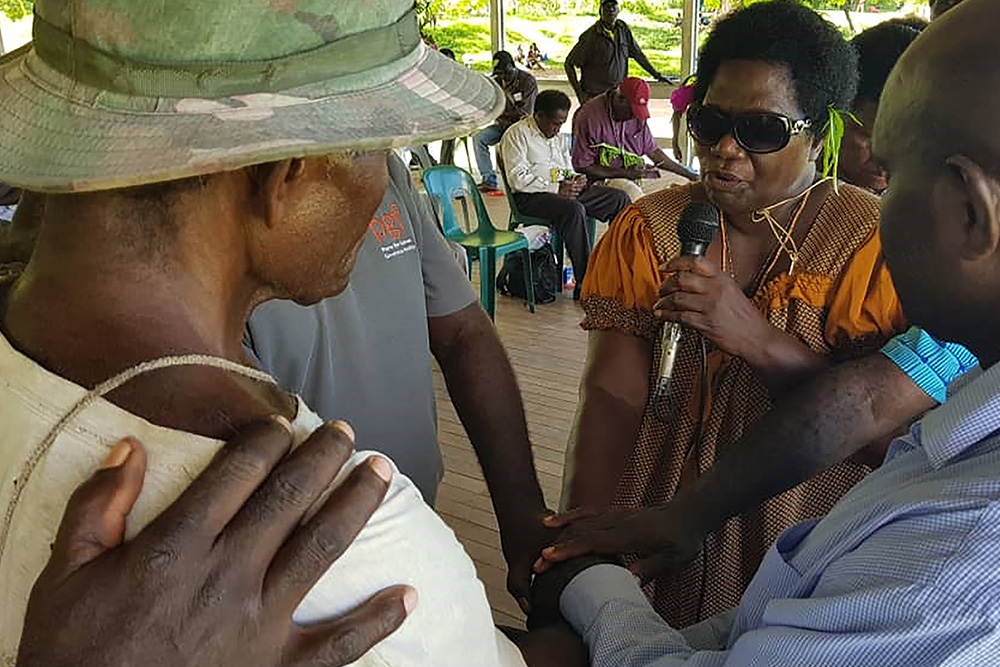
Women’s Leadership in an Era of Multimediation and Global Fragmentation
This blogpost was originally published by the Scottish Council on Global Affairs.
The era of a liberal, “blueprint” peacemaking approach, predominantly led by the Western world and multilateral institutions like the UN, to address conflict between a dyad of state-based belligerents, is receding. Contemporary conflicts are characterised by a web of embedded sub-national, national, and transnational rivalries. Peace is therefore increasingly pursued not as an end in itself but as a transactional instrument to secure geopolitical interests and influence by third-party intervenors.
The previously dominant blueprint is now being replaced by a more polycentric global order and the emergence of “multi-mediation” that is reflected by a constellation of parallel and competing peace processes led by singular states or blocs. The emergence of multi-mediation has implications for women’s leadership in peacemaking, particularly as it coincides with global retrenchment of the Women, Peace and Security (WPS) agenda, which has often been fundamental for supporting and resourcing women’s peace work. However, WPS has also been criticised for prioritising women’s tokenist inclusion over substantive influence in peace processes. The current moment therefore offers an opportunity to reflect, take stock and explore how leveraging women’s leadership can provide a competitive edge for WPS actors to tackle the challenges that fragmentation and multi-mediation presents.
Moving from Presence to Process Ownership
A core challenge for WPS implementation has been the phenomenon of “gender-washing” or tokenism, where women are included for symbolic or tokenistic representation without being granted substantive agency or process ownership. In fragmented settings, where formal peace processes often fail to translate into local change, women’s leadership must be directional and transformative. Women’s leadership experiences in Kenya show that true non-tokenistic leadership demands that women are present before a crisis to design conflict prevention policies, during a crisis to steer response, and after a crisis to guide implementation and transition.
Substantive agency is particularly important in fragmented conflicts, where the multiplicity of peace processes means that women’s meaningful contributions would be valuable across different mediation initiatives. To avoid tokenism, mediation actors should move beyond “veneer of inclusion” mechanisms (like advisory boards without decision-making power). Implementing clear criteria for full, equal, safe, and meaningful participation ensures that women’s groups have direct access to decision-making fora and that their agendas substantially impact the core political and economic outcomes of peace agreements.
Navigating the Cultural Duality of Power
In fragmented, identity-driven conflicts, peace is secured not by legal fiat but by local buy-in. Often the most sophisticated form of peacemaking is one of cultural negotiation, where the goal is to expand the space for women’s influence without triggering a backlash that could further fragment social cohesion. This cultural negotiation is foundational for WPS work in contexts such as Fiji, where “cultural duality” undermines women’s formal power. While women may achieve leadership in non-traditional urban or professional settings, their influence collapses upon re-entry into traditional, rural, or familial spaces where patriarchal norms remain dominant.
Culturally adaptive strategies avoid confrontation and instead focus on internal transformation. An interesting model to explore is intervention through building the capacity of women to articulate their concerns effectively, while simultaneously working to socialise male traditional leaders into the value of inclusive decision-making. This strategy is in itself an example of leadership that utilises the existing framework of community authority, namely the traditional structure, rather than attempting to bypass it, making inclusion durable and legitimate within the local context. This approach further addresses a critical limitation of the top-down WPS agenda and the failure to adequately account for local cultural resistance to gender parity.
The Strategic Power of the Informal Network
In contested states, the most robust source of authority often resides in informal local networks and traditional mechanisms. Leadership demonstrates the iterative and non-linear nature of peacemaking in fragmented conflicts – informal legitimacy both precedes and enables formal political power, reversing the typical top-down approach. Women’s efforts in Bougainville underscore the strategic advantage of grassroots legitimacy in navigating a post-conflict, decentralised setting. Women’s leadership drew upon instinctive, relational, and customary wisdom – qualities often undervalued in formal peacemaking.
This approach establishes a powerful formal-informal bridge. The initial work focused on deep community-based reconciliation and the creation of the Bougainville Women’s Federation – a bottom-up collective. This social capital created legitimacy and provided the foundational political capital that allowed some women to successfully transition into formal political roles, and then institutionalise women’s concerns by developing a WPS policy. The informal network became the political constituency and demand generator for the formal policy, which has implications for gender relations and peacebuilding across the whole of society.
Peacemaking as Comprehensive Human Security
WPS interventions in Trinidad and Tobago highlight that in many fragmented contexts, the primary threat is not an interstate war, but a breakdown of human security driven by transnational organised crime, gang violence, and a culture of impunity (including widespread Gender-Based Violence or GBV). Leadership requires adaptability of approaches to suit the context and in this case, traditional definitions of peacemaking, which no longer fit the complexity and diversity of conflict actors. Instead, this adaptability explicitly links women’s leadership to social justice and violence prevention. By tackling GBV and gun violence simultaneously, women leaders address the immediate and tangible insecurity felt by communities, making their peacebuilding efforts directly relevant and indispensable. This comprehensive approach grants them broader legitimacy and support.
This approach is a definitive rebuttal to the traditional militarised and elite-focused definition of security. In fragmented settings, peace is not merely the absence of political war but the presence of community safety and justice. Women’s leadership, by gravitating toward the protection of vulnerable groups and the addressing of social harms, is uniquely positioned to lead this human security model, making it the most resilient form of peacemaking against the systemic chaos of fragmentation.
Implications for Policy and Practice
To adapt these lessons for an age characterised by diffuse conflicts, weak central states, and multiple non-state actors, the focus of interventions by policymakers and practitioners must shift to decentralised, durable, and culturally grounded mechanisms.
Recommendation 1: Institutionalise Women’s Authority in Sub-National Governance. Move beyond demanding seats at collapsed or irrelevant national peace tables. Instead, support women to secure permanent, decision-making roles in sub-national, local, and parallel governance structures such as local councils, municipal bodies, and informal community peace committees. Focus on capacity building for local political advocacy and election preparedness to ensure women can translate their peacebuilding expertise into tangible, authorised community power, making their leadership resilient against state fragmentation and the challenges of multimediation
Recommendation 2: Fund and Support Adaptive, Customary Peacemaking Infrastructures. Prioritise investment in peacemaking infrastructures such as civic movements and localised women’s mediation communities that can operate within and across fragmented conflicts. In order to overcome resistance from traditional or customary authorities, funding and support must be flexible for women to adapt interventions as local sources of authority that shift within the conflict ecosystem. Co-designing interventions with local communities can ensure that models are culturally appropriate to prevent backlash against women’s leadership.
Recommendation 3: Embed Women Leaders as Drivers of Holistic Security and Justice. Recognise that in fragmented conflicts, security threats are overwhelmingly local and can include GBV, gang violence, and impunity. Women’s leadership must be the central vehicle for addressing this holistic security deficit. Resource women-led organisations to systematically integrate peacebuilding with transitional justice efforts at the community level such as local reconciliation, truth-telling, and managing programs that simultaneously tackle social violence and political polarisation. This broad mandate ensures their work remains relevant even when formal peace talks stall.
Recommendation 4: Build Partnerships for Visibility and Accountability. Counter the risk of tokenism by ensuring women leaders’ voices and actions are highly visible and their power is non-negotiable. Establish and fund partnerships with local, regional, and women-led media outlets to systematically amplify the peacebuilding narratives and policy recommendations of women leaders This visibility creates accountability for local power holders and protects women peacebuilders by elevating their profile.
Concluding Reflections – Women’s Leadership as a Strategic Methodology
The current era of global fragmentation and polycentric multi-mediation provides an opportune moment to reboot the WPS agenda into one that move beyond tokenism and “gender-washing”, and to embrace Women’s Leadership as a powerful strategic methodology for achieving peace and stability. Evidence from diverse contexts, such as Fiji, Bougainville, Kenya and Trinidad and Tobago, reveals that women leaders, by securing process ownership and leveraging informal networks, offer an adaptive, culturally grounded, and decentralised approach that excels where traditional top-down blueprints fail. They redefine security by prioritising community-level human security and justice over political warfare, building lasting social capital and securing crucial local buy-in. Therefore, the mandate for policymakers and practitioners is to treat the WPS agenda as a strategic imperative, and women’s leadership as a critical leverage for institutionalising women’s authority within peacemaking ecosystems, institutions and processes, through sub-national governance and funding adaptive customary infrastructures, making their resilient, localised leadership the central vehicle for forging durable societal foundations in this complex new global landscape.
Funding Acknowledgement: This blogpost draws on the author’s contributions to a SCGA-funded workshop on ‘Women, Peace and Security in the Age of Fragmentation’ held at Edinburgh Law School in October 2025, and lessons from case studies of women’s peace leadership in Bougainville, Fiji, Kenya and Trinidad and Tobago, supported by Peace Direct and published at Peace Insight.
About the Author: Salma Yusuf is an International Lawyer and Senior Specialist Consultant on democratisation, governance, peacebuilding, transitional justice, and human rights. She has advised the United Nations, Commonwealth, governments, civil society, academia, and international institutions on policy design, dialogue facilitation, program implementation, and training. Currently Visiting Professor at the University of Salamanca, Spain, Salma has also taught at university programs in Colombo, Sydney, and Northumbria and served as Academic Supervisor at University of Peradeniya in Sri Lanka. She led Sri Lanka’s first National Policy on Reconciliation and Coexistence, served as Deputy Director of Law, Policy and Human Rights at the Office for National Unity and Reconciliation, and is a Board Member of the Women Mediators across the Commonwealth Network. She is a Salzburg Global Fellow, a Senior Fellow at the Institute of Global Negotiations, Switzerland, and a PeaceRep Senior Policy Affiliate at University of Edinburgh. She holds a Master of Laws in Public International Law from Queen Mary University of London and a Bachelor of Laws from the University of London. She is an Attorney-at-Law of the Supreme Court of Sri Lanka.
This blogpost was originally published by the Scottish Council on Global Affairs.