In this blog, Nisar Majid, Khalif Abdirahman, Juweria Ali and Guhad Adan introduce a research report recently produced by PeaceRep Somalia concerning Ethiopia and Somalia’s political and security entanglement. The report explores the penetration of a market logic, framed as a political marketplace, that has evolved between the two countries, and is focused on – but not limited to – the Somali-speaking regions.
While this logic informs Somalia’s own political evolution for a much longer period, the authors identify two critical junctures in Ethiopia’s recent past in which a market logic has developed and intensified.
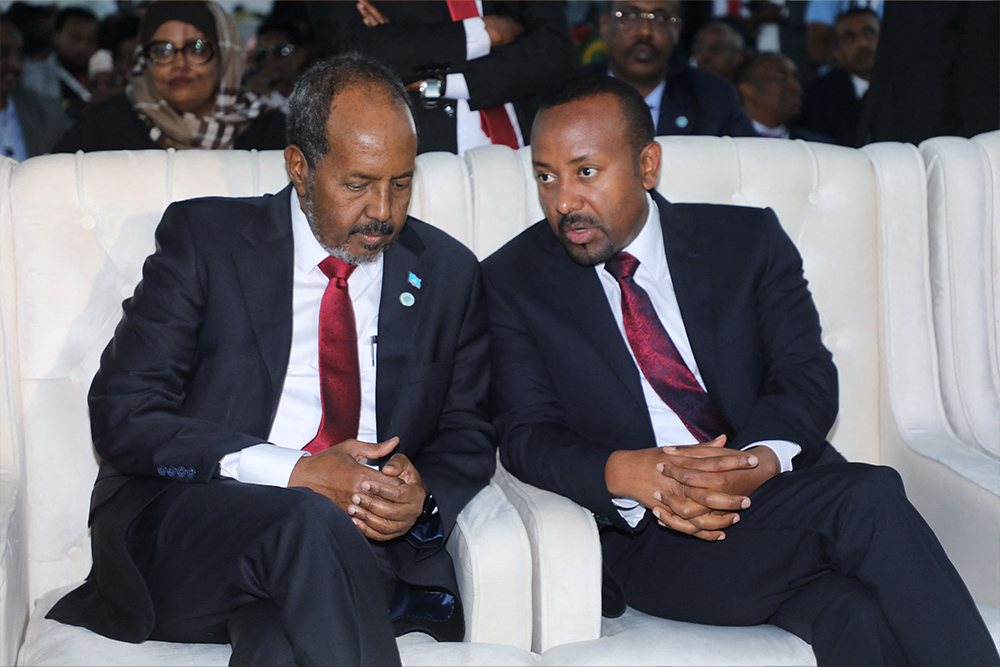
Entangled Neighbours: Ethiopia, Somalia, and the Rise of the Political Marketplace
Over the last 30 years, Ethiopia’s political and security influence and entanglement in Somalia has been profound. Initially, in the early 1990s, the newly empowered Ethiopia People’s Revolutionary Democratic Front (EPRDF), led by the Tigrayan People’s Liberation Front (TPLF), asserted its dominance over the federal government system in Ethiopia. This took place while Somalia’s central state collapsed and its post-state political order evolved in a more fragmented manner, with the polities of Somaliland and Puntland emerging as the two most coherent forms of authority since.
However, following the death of Meles Zenawi in 2012, Ethiopia’s internal coherence and state-party discipline loosened. At the same time, Somalia was undergoing its own political evolution under a newly recognised and internationally supported federal governmental system. When considering the entangled set of relations between Ethiopia and Somalia, the positionality of the Somali Regional State (SRS) within Ethiopia is particularly important. While the SRS is considered part of Ethiopia politically, it is economically (and culturally and linguistically) part of the wider Somali territories, comprising an integrated economic area. In addition, the vast border between Ethiopia and Somalia largely lies along the SRS-Somalia international boundary line, reflecting its colonial boundaries.
Ethiopia’s relationship with the SRS has long been driven by security imperatives, as has its relationship with neighbouring Somalia. This securitisation of domestic and foreign policy has itself been partially located within a regional and global security context defined by the ‘war-on-terror’, alongside additional insurgent activities within Ethiopia. As a result of these security dynamics, which have changed over time, Ethiopia has maintained a near permanent security presence within Somalia’s territory and has undertaken multiple small-scale and more significant military incursions over the years.
The report identifies two critical junctures in the development of a market logic. The first took place between 2010 and 2018, when the former President of the SRS, Abdi Mohamoud Omar (Abdi ‘Iley’) emerged as a dominant political entrepreneur, overseeing the security apparatus (the Liyu police) and the economy. He was thus able to mobilise a significant political budget in order to pursue his personal and political ambitions, both domestically within Ethiopia and across the region. His relationship with elements of the TPLF were crucial to his rise.
The second critical juncture is associated with the end of Abdi Iley’s regime and with a change of regime in both Addis Ababa and the SRS. This has resulted in a shift from a monopolistic security and business environment, centred on Abdi Iley, to a more decentralised context with a broader set of actors and relationships – but with the continuation of a market logic.
The implications of these changes in relation to Ethiopia and the Ethiopia-Somalia entanglement are significant. It is important to recognise the growing influence of market logics in Ethiopia’s political and security landscape, particularly for understanding policy coherence within Ethiopia, cross-border conflict in the Ethiopia-Somalia regions, and core-periphery relations in Somalia itself.
It is also the case that Ethiopia has become a more unpredictable neighbour towards Somalia compared to the EPRDF years – not only as a market logic has developed but also as regional dynamics are evolving across the Red Sea arena. This can create a disconnect between policy positions in Addis Ababa and developments at local levels in the Ethiopia-Somalia border areas, where we see local deal-making environments emerge.
Finally, the report suggests that policymakers and analysts need to take into account the proliferation of brokers – who often have competing interests – operating both locally (within Ethiopia) and across Somalia’s sub-regions, which is an outcome of an expanded transactional logic across this territorial space.
About the authors
Dr Nisar Majid is the research director for the PeaceRep Somalia programme at the Conflict & Civicness Research Group at LSE. He has worked in and on the Horn of Africa and the Somali territories for over 20 years, in various
applied and research capacities.
Khalif Abdirahman is the PeaceRep Somalia research team’s senior field researcher with the Conflict & Civicness Research Group at LSE. Khalif is also a Fellow at the Rift Valley Institute.
Juweria Ali is a Postdoctoral Research Fellow at the University of Westminster’s Centre for the Study of Democracy (CSD), a Research Associate at LSE and contributor to PeaceRep Somalia. Her research focuses on political violence, post-war governance, and the processes of nation and state-building in the Horn of Africa.
Guhad Adan is an independent consultant. He has participated in many studies, reviews and evaluations in Somalia on a wide range of sectors and themes. He has worked with ODI and on the LSE Conflict Research Programme (CRP-Somalia) as well as PeaceRep Somalia. He is a Research Associate at LSE.